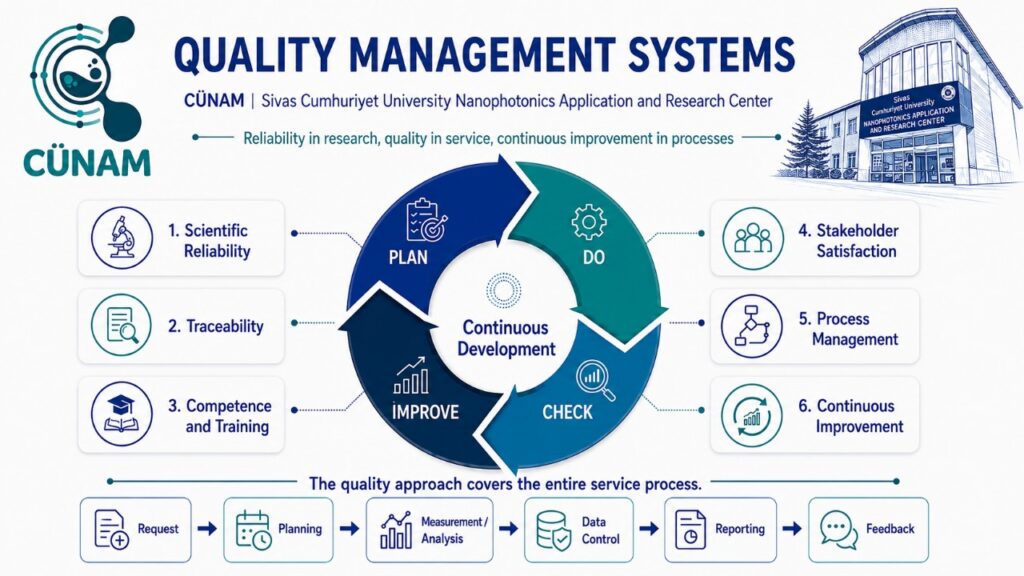
Quality Management Systems
Sivas Cumhuriyet University Nanophotonics Application and Research Center (CÜNAM) adopts a quality management approach based on the principles of scientific reliability, traceability, sustainability, stakeholder satisfaction, and continuous improvement in its research, analysis, characterization, training, and R&D activities.
The fundamental basis of our quality approach is to ensure that the activities carried out at the Center are conducted in compliance with scientific and technical requirements and that the needs of researchers, students, public institutions, and industrial organizations are met effectively, reliably, and sustainably.
Our Quality Policy
As CÜNAM, we are committed to:
- Ensuring scientific and technical quality in research, analysis, characterization, training, and R&D activities,
- Supporting reliability, repeatability, and traceability in measurement and analysis processes,
- Conducting service processes in a systematic, transparent, and sustainable manner,
- Continuously improving service quality by taking user and stakeholder needs into consideration,
- Ensuring the effective, safe, and efficient use of research infrastructure,
- Supporting the technical competence of personnel and equipment users through training and continuous professional development activities,
- Considering occupational health and safety, environmental responsibility, ethics, and sustainability as integral components of our activities,
- Supporting university–industry collaboration and interdisciplinary research,
- Following national and international scientific and technological developments,
- Regularly evaluating our processes and promoting continuous improvement.
These principles constitute the fundamental elements of our quality policy.
Our Quality Management Approach
At CÜNAM, quality is considered as a holistic process that is not limited solely to measurement or analysis results, but extends from the receipt of a service request through the completion of the service and the evaluation of stakeholder feedback.
Request and Service Management
User requests are evaluated to determine the appropriate equipment, method, and operating conditions, and the service process is carried out in a planned and systematic manner.
Measurement and Analysis Processes
Equipment is operated under appropriate working conditions, measurement parameters are recorded, and results are evaluated in accordance with scientific and technical criteria.
Equipment and Infrastructure Management
In order to support the continuity and reliability of the research infrastructure, maintenance, inspection, and other necessary technical processes related to equipment are systematically monitored.
Documentation and Traceability
Recording the activities performed, ensuring the traceability of processes, and maintaining the sustainability of institutional knowledge are important components of our quality management approach.
Competence and Training
Training activities aimed at improving the technical knowledge, practical skills, and equipment operation competence of personnel and users are actively supported.
Stakeholder Satisfaction
Feedback received from researchers, students, public institutions, and industrial organizations is regarded as an important input in the evaluation and continuous improvement of service processes.
Continuous Improvement
Processes are regularly reviewed in line with evolving needs, performance outcomes, and stakeholder feedback. Improvement activities are carried out to enhance research capacity, service quality, and operational efficiency.
Our Quality Objective
CÜNAM’s quality objective is to establish a user-oriented, traceable, sustainable, and continuously improving research and service environment with a high level of scientific reliability through the effective use of advanced research infrastructure; to strengthen university–industry collaboration; and to contribute to scientific research and Türkiye’s national R&D capacity.
CÜNAM is committed to continuously reviewing and improving its quality management approach in response to changing needs, scientific and technological developments, and stakeholder feedback.